Searches for gravitational waves from precessing binary black holes
Advisor: Prof. Sarah Caudill [UMass Dartmouth]
Collaborator: Dr. Stefano Schmidt
We work on improving the sensitivity of gravitational-wave search pipelines to binary black holes (BBHs) with precessing spins. When the spins of the two black holes are misaligned with the orbital angular momentum, the orbital plane precesses and leaves a distinctive imprint on the emitted signal, one that current searches are not well tuned to capture.
A matched-filtering search targeting these systems, led by Dr. Stefano Schmidt, used the GstLAL pipeline to look for asymmetric BBHs with heavily misaligned spins in LIGO and Virgo data from the third observing run. After quantifying the sensitivity gained over standard spin-aligned searches, the search recovered 30 events already present in the Gravitational-Wave Transient Catalog but found no additional significant candidates. The resulting upper limit on the merger rate of a hypothetical subpopulation of asymmetric, heavily precessing signals is consistent with current LIGO-Virgo-KAGRA estimates, ruling out a yet-undiscovered population of such binaries. I contributed to this work by running the search pipeline over portions of the observing run data. The paper is published in Physical Review Letters.
Our current project takes a cheaper route to the same goal. Fully precessing template banks span a much larger parameter space than aligned-spin ones, and both generating and filtering against them is computationally expensive. Precessing signals do still appear as high signal-to-noise ratio (SNR) triggers in existing aligned-spin searches. They simply fit the templates poorly, so the χ2 signal-consistency tests that separate signals from noise flag them as a bad match, and the candidates get down-ranked or misclassified as noise. We are developing a method that takes these existing aligned-spin triggers from the SGNL pipeline and rapidly re-evaluates and optimizes their SNR and signal-consistency values, recovering precessing candidates without the overhead of a full precessing search.
Identification of witness channels for LIGO's glitches
Advisor: Prof. Sarah Caudill [UMass Dartmouth]
Collaborator: Dr. Melissa Lopez [Nikhef]
Gravitational-wave (GW) interferometers are highly sensitive instruments, and while they are built to detect weak astrophysical signals, they are also susceptible to non-Gaussian transient noise artifacts known as glitches. Glitches exhibit a wide range of time-frequency morphologies and can interfere with both the detection and the parameter estimation of GW signals in the main detector strain. Understanding whether a glitch is instrumental or environmental in origin is important for identifying and mitigating its effects. GW detectors record data from over 200,000 auxiliary channels that monitor the state of the instrument and its environment; many glitches originate in these channels and are reflected in the strain h(t).
This work builds on a recent study that used an unsupervised algorithm to identify anomalous glitches relying on auxiliary channels alone. Following that approach, we encode a subset of auxiliary channels from the LIGO detectors in the fractal dimension (FD), a measure of the complexity of a signal, and we have developed a GPU-accelerated pipeline to compute the FD across large datasets, opening the way to near-real-time analysis. Using these FD-encoded representations, we train an unsupervised convolutional autoencoder on an expanded set of auxiliary channels to learn the underlying data distribution. Our goal is to identify the witness channels associated with distinct glitch populations using auxiliary information alone, accelerating glitch identification and mitigation and, in turn, improving GW data analysis.
SGNL and low-latency alert infrastructure
I am part of the group developing SGNL, the gravitational-wave search pipeline that will replace GstLAL, and I contribute to SGN-LLAI, a library in the same sgn* family that provides the low-latency alert infrastructure for the fifth observing run (O5) and beyond.
Gravitational waves from eccentric magnetar binaries
Advisor: Prof. Prayush Kumar [ICTS-TIFR]
Collaborator: Dr. Prasad Ravichandran [ICTS-TIFR]
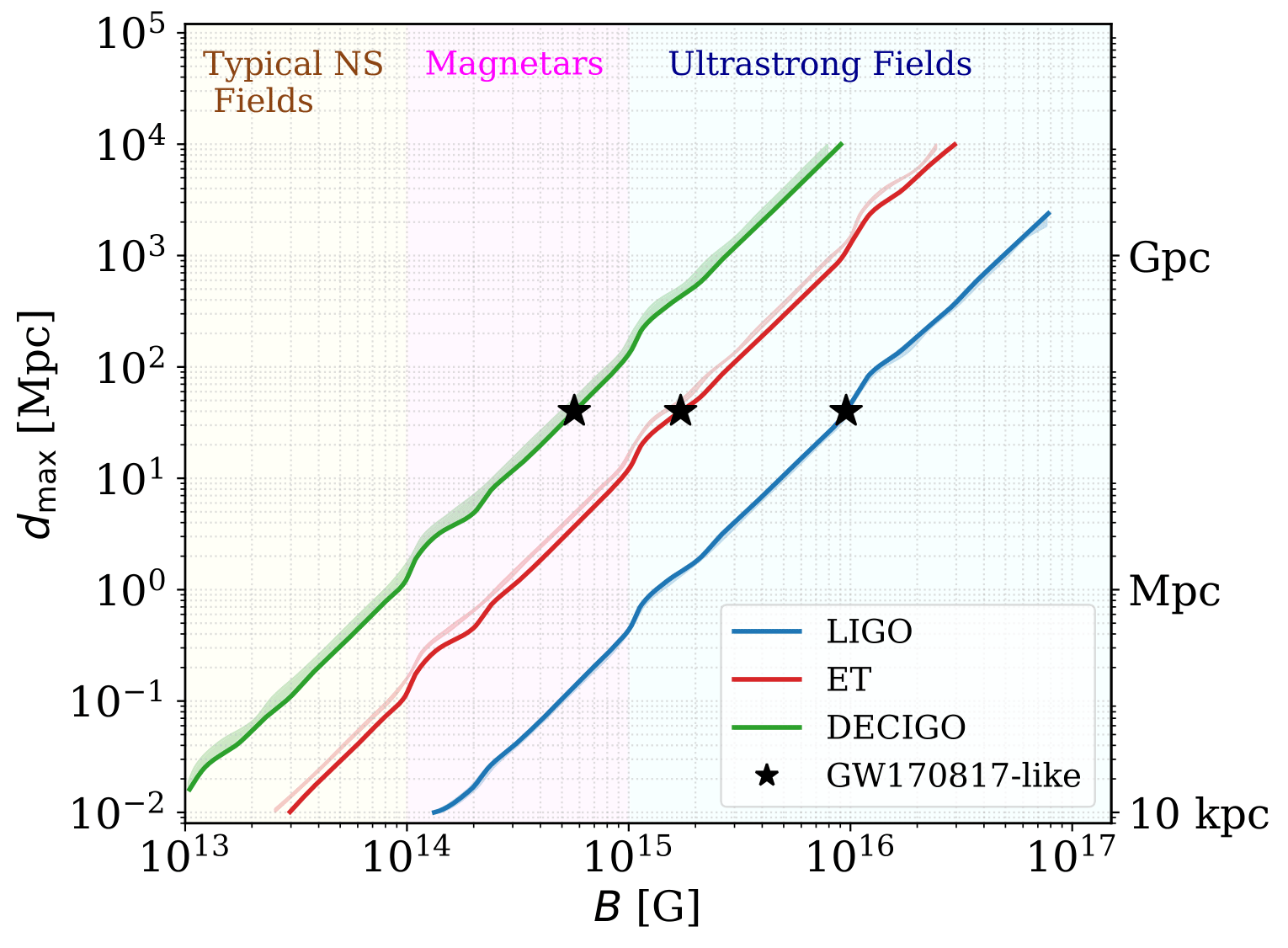
This research explores the imprint of strong magnetic fields on gravitational waves emitted by eccentric binary neutron star systems. While standard waveform models often neglect magnetic fields, binaries formed through dynamical capture can retain significant eccentricity and strong magnetic fields until their final inspiral stages. Our work investigates the detectability of these magnetic signatures.
Using a perturbative framework, we analytically computed the orbital evolution and the resulting GW phase shift by modeling two key magnetic effects: the mutual magnetic interaction between the neutron stars and the electromagnetic radiation from the system's effective dipole. Our analysis reveals that while current detectors like LIGO are limited to detecting very strong fields at galactic distances, next-generation observatories will be transformative. For binaries with strong magnetic fields, the Einstein Telescope and DECIGO could detect fields of 1015 G from several hundred megaparsecs away and extreme fields (1016 G) out to gigaparsec scales. These findings suggest that future GW observations can serve as a new probe to measure neutron star magnetic fields and shed light on their astrophysical formation channels. The paper is published in The Astrophysical Journal.
Detection and reconstruction of GWs from core-collapse supernovae
Advisors: Dr. Elena
Cuoco [University of Bologna], Dr. Alberto Iess [Laboratoire d'Annecy De Physique Des Particules (LAPP)]
Core-collapse supernovae (CCSNe) are a type of burst signals that have eluded detection so
far, and a significant effort is therefore being put into achieving a detection in coming
years. Compared to binary mergers, core-collapse supernovae cannot be modelled precisely,
and it is, therefore, impossible to apply classical matched filter techniques for detection
and analysis. In this project, we utilized a wavelet-based detection pipeline, the Wavelet
Detection Filter (WDF), to generate event triggers. We developed a clustering algorithm to
group triggers associated with a single event. Using WDF parameters, we successfully
reconstructed the injected signal with a good accuracy. My Master's thesis can be found here.
Multiclass Classification for Standard Model Processes
Advisor: Prof. Sourabh
Dube [IISER Pune]
We worked on developing a complex artificial neural network, which incorporated 24 input
variables like missing transverse energy and the count of b-jets. Our investigation primarily revolved around utilizing CMS data from 2017 and 2018,
specifically focusing on events characterized by multilepton final states. With the neural
network we created, we were able to categorize these events into three Standard Model
processes: ZZ, WZ, and the ttZ process. By studying the output distribution of the network,
we gained insights into the complex relationships among the input variables.
Convolutional neural networks for particle track classification
Advisor: Prof. Sourabh
Dube [IISER Pune]
We set out to reproduce work from a previous Master's thesis. Using a toy detector
model, we generated two sets of images pertaining to signal and background. Our aim was to
train a convolutional neural network to classify between these two classes. Prior to this, we
designed and trained a binary neural network to distinguish Drell-Yan and ttbar
processes.